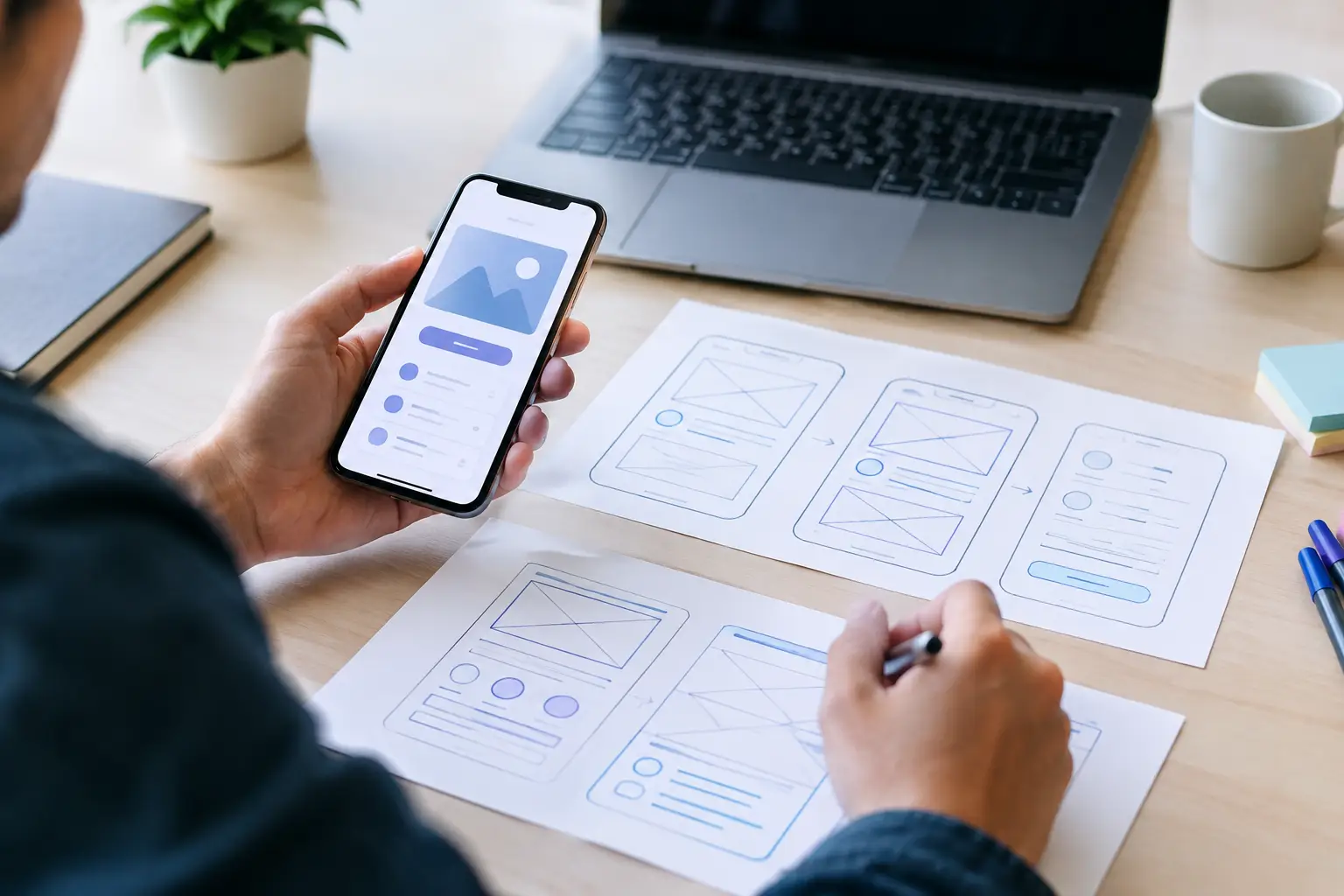
A product discovery workshop is where an expensive assumption becomes a testable plan. Before your team invests weeks in screens, code, integrations, and launch campaigns, it needs agreement on one thing: what problem is worth solving first. This product discovery workshop guide shows how to create that alignment, make hard scope decisions, and leave with an MVP ready for execution.
For founders and product leaders, discovery is not a slow pre-project ritual. Done well, it is a focused decision-making process that removes ambiguity early, protects the budget, and gives design and engineering a clear starting point. The goal is not to create a perfect specification. The goal is to make the next build decision with evidence, priorities, and commercial context.
What a product discovery workshop guide should achieve
A strong workshop turns broad ambition into a practical product direction. You should leave knowing who the product serves, what job it must help them accomplish, which user flow creates the most value, and what can wait until after launch.
That last point matters. Most digital products do not fail because teams lack ideas. They fail because the first release tries to serve every audience, solve every edge case, and include every feature suggested in a planning call. Discovery creates the discipline to define a smaller, sharper first version.
The core outputs should be clear enough for a design and development team to act on immediately:
- A prioritized problem statement tied to a business goal
- Defined target users and the context in which they use the product
- A mapped primary user journey, from entry point to successful outcome
- A prioritized MVP feature set, including what is deliberately out of scope
- Technical, operational, and compliance constraints that affect the build
- Success metrics for launch and the first iteration cycle
These outputs are connected. A user journey without priorities becomes a diagram. A feature list without business goals becomes a backlog. The workshop earns its value when every decision supports a defined outcome, such as increasing qualified leads, reducing manual work, improving activation, or validating willingness to pay.
Start with the decision, not the agenda
The most effective workshop planning begins with a simple question: what must be true by the end of the session for the project to move forward confidently?
For an early-stage startup, the decision may be whether the proposed product solves a painful enough problem to justify an MVP. For a growing business, it may be which workflow to automate first. For an established brand, it may be how to redesign a conversion path without disrupting critical operations.
This decision shapes the participants, exercises, and level of detail. A two-day workshop is unnecessary if the team only needs to prioritize a landing page conversion flow. On the other hand, a marketplace, healthcare platform, or multi-role SaaS product may require deeper work on permissions, data flows, integrations, and risk.
Avoid bringing people into the room simply because they are senior. Include the people who understand customer demand, commercial priorities, operations, and delivery constraints. In many cases, that means a founder or executive sponsor, product lead, marketing or sales representative, operations lead, and technical lead. A skilled facilitator keeps the discussion moving when those perspectives conflict.
Prepare evidence before the session
Workshops become speculative when teams arrive with opinions but no evidence. Pre-work does not need to be heavy, but it should give participants a shared view of the current situation.
Collect customer interview notes, support tickets, sales objections, usage data, competitor observations, existing process maps, and prior research. If the product already exists, review analytics around drop-off points, activation, retention, and high-volume support requests. If it does not, bring the strongest available signals from the market.
You do not need exhaustive research to start. You do need enough evidence to challenge assumptions. A founder may believe customers want an all-in-one dashboard, while interviews reveal that customers would pay first for a faster approval workflow. That distinction can save months of building.
Run the workshop in the right sequence
A practical product discovery workshop usually fits into one intensive day or two shorter sessions. The format should create momentum without rushing the decisions that define scope.
Start by aligning on the business objective. Be specific. “Build a better customer experience” is not an objective. “Reduce abandoned applications by 20 percent within six months” gives the team a measurable direction.
Next, define the user with enough detail to guide product choices. A role title alone is rarely useful. Understand their trigger, current workaround, urgency, decision authority, and barriers. The person using the product may not be the one paying for it, which changes both the experience and the messaging.
Then map the primary journey. Focus on the critical path that delivers the product’s central value. For example, a service marketplace might prioritize the path from search to booking confirmation. A B2B tool might prioritize the path from invitation to first completed workflow. Keep the map grounded in real behavior, not ideal behavior.
Once the journey is visible, identify friction points and opportunities. Ask where users hesitate, what information they need before committing, which steps require trust, and where internal teams currently spend time manually resolving issues. This is where design, business, and technical perspectives should meet.
Only after that should the group prioritize features. Features are solutions, not starting points. A useful exercise is to evaluate each feature against three questions: Does it directly support the primary user outcome? Does it help achieve the business goal? Can the team deliver it within the intended launch window?
A feature that scores poorly should not disappear forever. It should move to a later release, where it can be validated against real user behavior instead of assumptions.
Separate MVP from minimum effort
An MVP is not a stripped-down product that feels unfinished. It is the smallest version that can deliver a credible result for a specific user and generate meaningful learning for the business.
That may require more polish in one area than teams expect. If trust is central to conversion, the MVP may need clear pricing, proof points, secure payment flows, thoughtful onboarding, and reliable notifications. Cutting those elements to save time can undermine the test itself.
At the same time, an MVP does not need every automation, reporting view, admin feature, or integration requested by stakeholders. Manual operations can be acceptable in the short term if they help validate demand without compromising the customer experience. The right balance depends on volume, risk, and the promise your brand makes at launch.
Define constraints before design begins
A polished interface cannot compensate for an ignored constraint. During discovery, document the realities that will shape the product: required integrations, payment providers, data migration needs, privacy expectations, user roles, internal approval processes, platform requirements, and deadlines tied to campaigns or fundraising.
Technical constraints should inform the solution early, not arrive as a late-stage veto. If an MVP needs to launch quickly, a no-code or low-code approach may be the right first move. If it handles sensitive data, requires complex logic, or needs to support rapid scale, custom development may be the better foundation.
Neither path is automatically superior. The decision depends on the product’s risk profile, expected usage, speed requirements, and future roadmap. A capable partner can help teams make that trade-off without forcing the entire product into one preferred toolset.
Turn workshop outputs into a build plan
The workshop is only valuable if its decisions survive the following week. Within a few days, turn the working artifacts into a concise product brief that captures the problem, audience, primary journey, MVP scope, assumptions, constraints, and success metrics.
The brief should also identify unresolved questions. This is not a weakness. It is better to name uncertainty than quietly build around it. Some questions require user interviews, prototype testing, technical spikes, or legal review before development starts.
From there, the team can move into user flows, wireframes, visual design, technical architecture, and delivery planning. At PixoryFlow, this handoff is designed to stay connected: the strategic decisions made in discovery inform the experience, the build, and the launch plan rather than being filed away after kickoff.
Common workshop mistakes that slow launches
The most common mistake is treating consensus as the goal. Teams can agree on a vague vision and still leave without a decision. Product discovery should create productive tension around priorities, because every launch has limits on time, budget, and attention.
Another mistake is allowing feature discussions to dominate before the user problem is clear. This usually rewards the loudest stakeholder and produces a bloated backlog. Bring the conversation back to the primary journey and measurable business outcome.
Finally, do not confuse documentation with progress. A long deck, detailed persona profiles, and a sprawling roadmap may look complete, but they do not guarantee launch readiness. The useful test is simple: can the design and development team explain what they are building first, for whom, why it matters, and how success will be measured?
A well-run workshop gives your team permission to move faster because it removes the costly ambiguity that causes rework. Make the hard calls early, protect the MVP from unnecessary scope, and treat the first launch as a focused step toward a product your market can actually use.