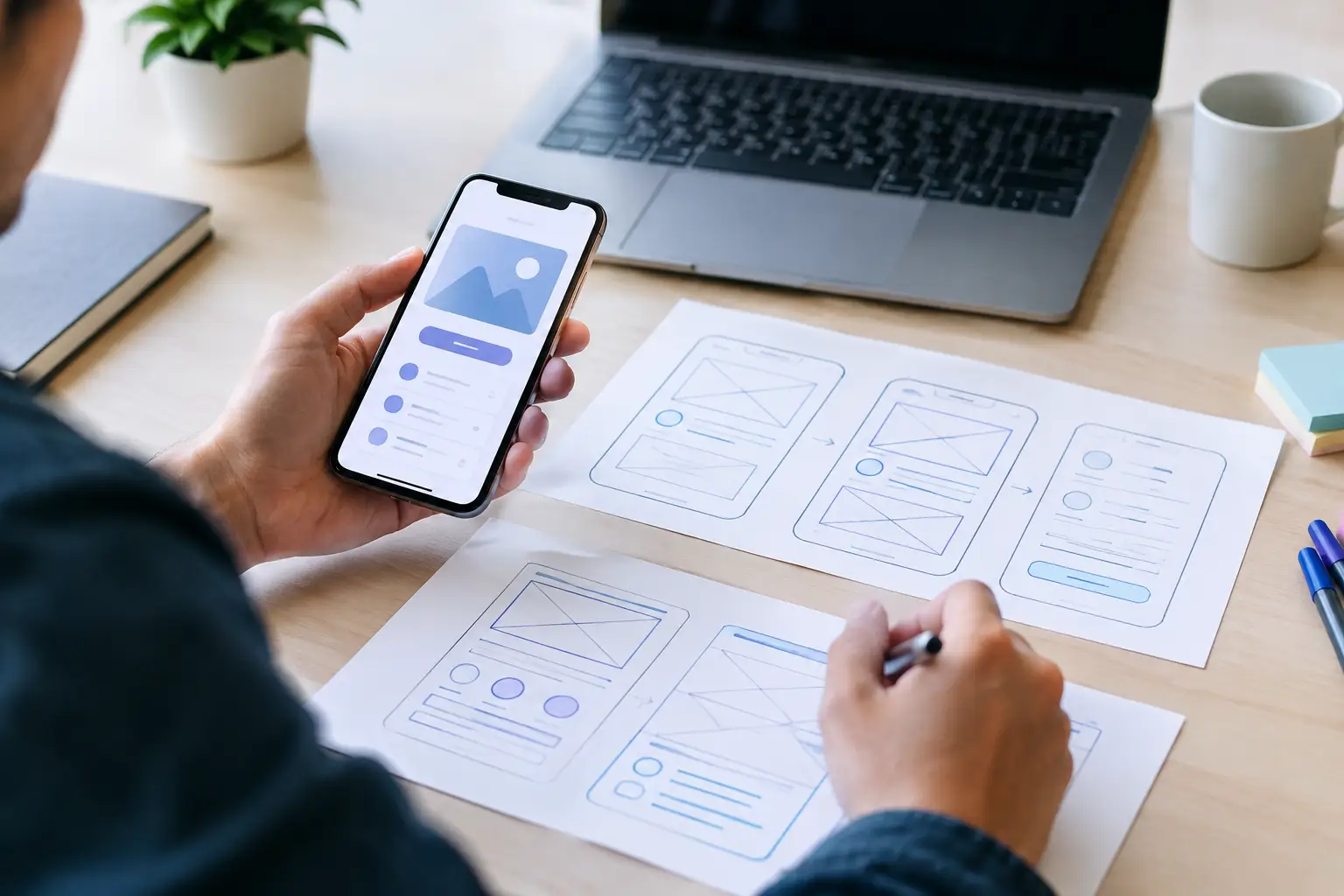
A founder can spend $5,000 on an app prototype and get a clear answer from real users. Another can spend $50,000 and still have little more than attractive screens. The difference is not just design quality. It is scope, fidelity, technical depth, and whether the prototype is built to answer a specific business question. So, how much does app prototyping cost? For most professional engagements, expect anywhere from $3,000 for a focused concept prototype to $75,000 or more for a high-fidelity, testable product experience with complex flows.
The right budget is not the lowest number on a proposal. It is the amount required to reduce the most expensive uncertainty before development begins.
How Much Does App Prototyping Cost?
App prototyping costs usually fall into four practical ranges. A simple low-fidelity prototype often costs $3,000 to $10,000. A polished clickable prototype for investor conversations, stakeholder alignment, or early usability testing typically lands between $10,000 and $30,000. A detailed prototype that includes research, a design system, multiple user roles, and advanced interactions can run $30,000 to $75,000.
If your team needs a coded prototype connected to real APIs, payment flows, authentication, or live data, the investment can reach $50,000 to $150,000+. At that point, you are no longer paying only for prototype design. You are funding early product engineering and creating assets that may carry into the MVP.
Those ranges overlap for a reason. A three-screen prototype for a consumer app may require less effort than a six-screen workflow for a B2B platform with permissions, approvals, and compliance considerations. Screen count matters, but workflow complexity matters more.
What You Are Actually Paying For
A strong prototype is not a collection of isolated UI screens. It is a decision-making tool. It should show how a user enters the product, completes a key task, encounters friction, recovers from an error, and reaches a meaningful outcome.
The work typically begins with product discovery. This phase clarifies the target user, the core problem, business goals, feature priorities, and the success metric for the prototype. For an early-stage startup, that may mean testing whether users understand a new marketplace concept. For an established brand, it may mean proving a faster account onboarding flow before committing development resources.
Next comes user flows and information architecture. Teams map the path through the product before polishing the interface. This prevents a common and costly mistake: approving beautiful screens that do not support the actual user journey.
Then comes interface design and prototyping. The design team creates the visual system, key screens, interaction states, and clickable paths. Higher-fidelity engagements may also include micro-interactions, responsive layouts, accessibility considerations, content direction, and usability testing preparation.
A premium prototype should leave your team with more than a presentation. It should provide a clear product direction, a prioritized MVP scope, and a foundation for efficient development.
The Factors That Change the Price
Prototype fidelity
Low-fidelity prototypes use wireframes and basic interactions to test structure and logic quickly. They are ideal when you need to validate a workflow, clarify requirements, or align internal stakeholders. They cost less because the visual design is intentionally limited.
High-fidelity prototypes look and behave much closer to the finished product. They use brand colors, typography, realistic content, refined components, transitions, and responsive behavior. This level is useful for investor demos, user testing, sales enablement, and handoff to engineering. It also takes longer to produce correctly.
The key trade-off is simple: do not buy visual polish before you know what needs to be tested. But do not use rough wireframes when the question is whether users trust the brand or understand a premium experience.
Number and complexity of user flows
A prototype with one core path, such as browsing products and requesting a quote, can move quickly. Add account creation, user profiles, dashboards, team permissions, notifications, subscriptions, checkout, and support workflows, and the scope expands fast.
Complexity also grows when the product serves more than one audience. A customer app, provider portal, and internal admin dashboard may share a business model, but each requires separate flows, screens, logic, and testing assumptions.
Research and validation
Some teams arrive with strong customer insight and a clear product brief. Others need help defining the opportunity before design begins. User interviews, competitor analysis, journey mapping, and usability testing increase the prototype budget, but they can prevent much larger losses later.
For example, a five-user usability test may expose a broken onboarding assumption before development starts. Correcting that issue in a prototype is relatively fast. Reworking it after engineering, QA, and launch planning is not.
Design system and brand maturity
If your brand already has established fonts, colors, components, and content guidelines, the design team can focus on product decisions. If the visual identity is incomplete, app prototyping may include foundational brand work, component design, iconography, and UI standards.
That investment is often worthwhile for growing businesses. A reusable design system helps keep future web, mobile, and marketing experiences consistent while reducing rework across product releases.
The team you choose
Freelancers may be a cost-effective fit for straightforward prototypes with a tightly defined brief. A specialist product design agency brings broader capabilities: strategy, UX, visual design, prototyping, testing, design systems, and a direct path into development.
The trade-off is not agency versus freelancer in the abstract. It is coordination risk versus scope control. If a prototype will move directly into an MVP, a partner that can design, build, and launch the product may reduce handoff gaps and preserve momentum.
Typical Budget Scenarios
A concept-validation prototype at $3,000 to $10,000 is best for testing a single product idea. It may include a workshop, user flow, wireframes, and a lightweight clickable prototype. This is the right move when your biggest question is, “Does this make sense to users?”
An MVP-ready design prototype at $10,000 to $30,000 usually includes detailed UX flows, high-fidelity UI for the core experience, a component library, and a prototype suitable for stakeholder review or usability testing. Many startups use this range to move from a product brief to a development-ready direction.
A complex product prototype at $30,000 to $75,000 often supports multiple user roles, detailed dashboards, edge cases, responsive designs, and structured testing. This range is common for SaaS platforms, operational tools, fintech concepts, and products where one missed workflow can create real business friction.
A coded proof of concept at $50,000 and above is appropriate when visual simulation is not enough. If you must verify API behavior, performance, data rules, hardware integration, or technical feasibility, engineering belongs in the prototype phase. The budget is higher, but the learning is more concrete.
How to Control Prototype Costs Without Cutting the Wrong Corners
Start with one critical user journey. The first version does not need to demonstrate every future feature. It needs to prove the action that creates value for the user and the business.
Set a clear learning objective before design starts. “We need an app prototype” is a deliverable request. “We need to learn whether operations managers will adopt a faster approval workflow” is a strategic objective. The second statement leads to better scope decisions.
Use realistic content where it affects comprehension. Placeholder text can hide confusion in financial summaries, healthcare forms, scheduling tools, or complex dashboards. Realistic sample data makes testing more useful, even when the product is not live.
Finally, decide whether the prototype is disposable or a foundation for the build. A quick validation prototype can be intentionally lightweight. If it will guide engineering, invest in documented flows, reusable components, responsive states, and a clean handoff package.
Treat the Prototype as a Risk-Reduction Asset
The cost of app prototyping should be measured against the cost of building the wrong thing. A focused $15,000 prototype that removes a weak feature, clarifies the MVP, and shortens development cycles can protect far more capital than it consumes.
PixoryFlow approaches prototyping as the bridge between product strategy and launch execution. The goal is not to create screens that impress in a meeting. It is to create a product direction your team can validate, fund, build, and bring to market with confidence.
Before requesting a quote, define the decision you need the prototype to support. When the question is precise, the scope gets sharper, the budget becomes more predictable, and every design hour works harder toward launch.