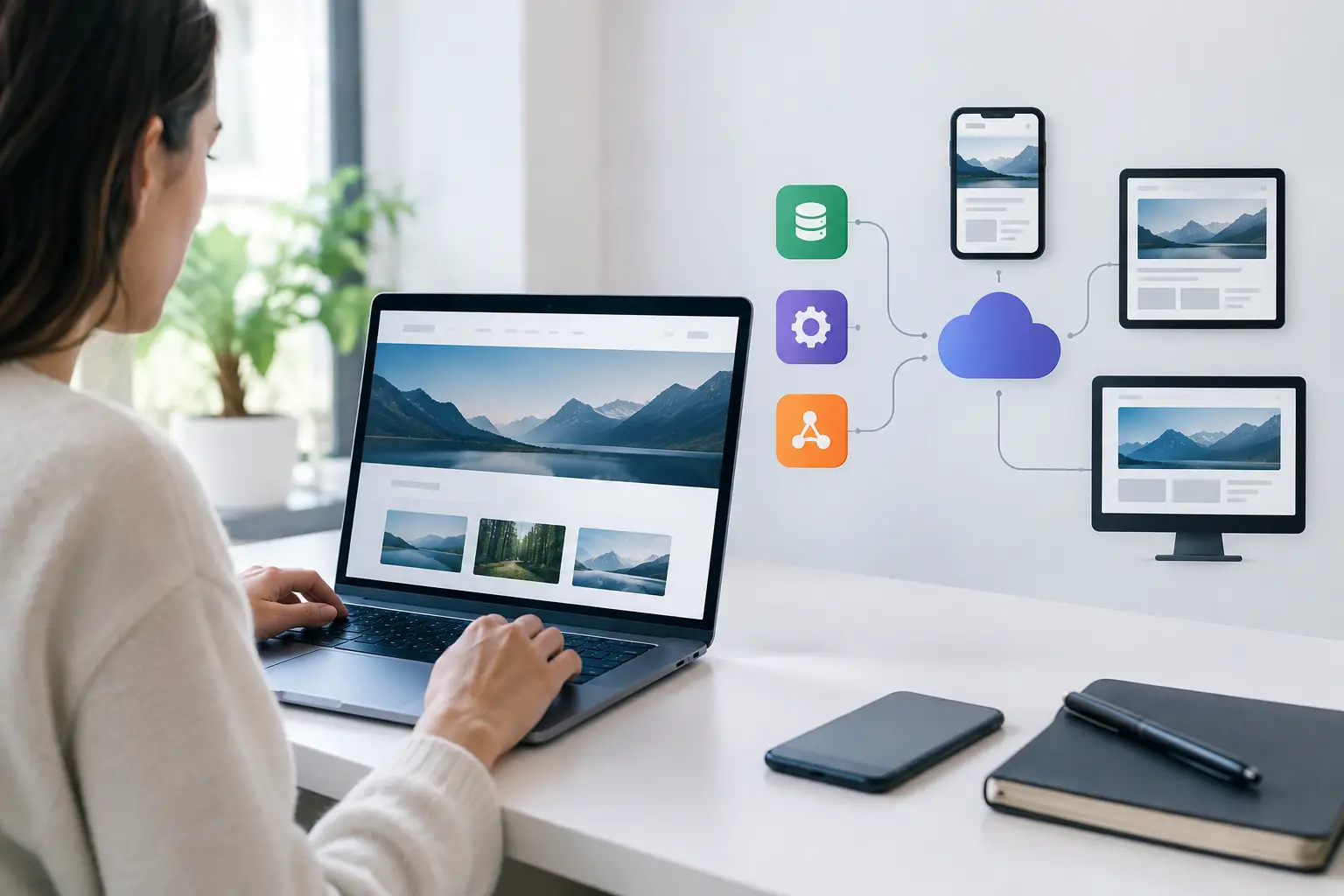
A marketing team changes a homepage message at 9 a.m. By noon, that same campaign needs to appear in a mobile app, an in-store display, a customer portal, and an email-triggered landing experience. The future of headless websites is being shaped by this operational reality: brands no longer publish to one screen, and they cannot afford to rebuild their digital foundation every time a new channel appears.
For ambitious companies, headless is not simply a technical preference. It is an architectural decision that affects launch speed, content workflows, conversion performance, experimentation, and the cost of future growth. Done well, it gives teams more control over the customer experience without tying every update to a development queue. Done poorly, it creates an expensive system that only engineers can confidently operate.
Why the Future of Headless Websites Is About Business Speed
A traditional website platform typically keeps the content management system, presentation layer, and templates tightly connected. That approach remains practical for many brochure sites and smaller marketing teams. It is familiar, efficient, and often quicker to manage when the website is the only destination that matters.
A headless architecture separates the content layer from the frontend customers see. Content is stored in a CMS and delivered through APIs, while the frontend can be built with the technology best suited to the experience. One source of content can support a website, app, kiosk, portal, or another future touchpoint.
That separation is what makes headless attractive to brands operating at speed. Product teams can improve the frontend without migrating years of content. Content teams can publish structured information for multiple channels. Engineers can build for performance, accessibility, and complex integrations without being constrained by a monolithic template system.
The advantage is not that headless makes every site faster to build on day one. It often does not. The advantage is that it reduces reinvention as requirements expand. A company launching a single campaign site has different needs from a business managing regions, product lines, logged-in experiences, and frequent growth experiments. Headless becomes more valuable as that complexity becomes real.
The Next Shift: From Decoupled Content to Composable Experiences
The next generation of headless websites will be less about decoupling for its own sake and more about composability. Rather than treating the website as one large build, teams will assemble digital experiences from reusable pieces: structured content, design-system components, commerce data, search, personalization, analytics, and customer data.
This matters because brands need change without chaos. A reusable product card, campaign module, testimonial block, or pricing section should behave consistently wherever it appears. Design quality improves because teams are not reinventing visual patterns. Development moves faster because proven components can be deployed across pages and products. Governance improves because updates happen in one controlled place.
Composable architecture also changes the role of design. In a template-led environment, design is often treated as a set of static page layouts. In a headless environment, the stronger approach is to design systems, rules, and modular content structures. The question becomes less about how one homepage looks and more about how a brand can create hundreds of on-brand pages without creating hundreds of one-off exceptions.
For a scaling business, that is a major operational gain. It turns design from a recurring production bottleneck into a system that supports faster publishing and more consistent execution.
AI Will Raise the Stakes for Content Structure
AI is accelerating the need for well-structured content. Generative tools can help teams produce first drafts, create content variations, tag assets, translate copy, and identify gaps across large content libraries. But AI cannot repair a weak information architecture after the fact.
If product data is inconsistent, campaign content is buried in rich-text fields, and page sections have no clear structure, automation will amplify confusion. Headless CMS platforms are well positioned because they encourage teams to define content models: what a product is, what a location is, what a case study needs, and which fields are required for each channel.
The brands that benefit most from AI-assisted publishing will not be those that generate the most copy. They will be those with clean content models, clear approval workflows, reusable components, and accountable editorial standards. Speed without governance creates brand drift. Structured systems create useful scale.
Personalization Will Move Beyond the Homepage
For years, personalization has often meant changing a homepage headline based on a visitor segment. The future is broader and more practical. Headless websites can combine content, behavior, location, account data, and product context to present more relevant journeys across an entire experience.
A returning prospect might see a different proof point than a first-time visitor. A customer in a specific industry might receive relevant case studies, integrations, or feature explanations. A logged-in user can move from marketing content into product workflows without the visual and functional disconnect that undermines trust.
That does not mean every brand should pursue highly individualized pages. Personalization has a cost: more data dependencies, more testing requirements, more privacy responsibilities, and more potential failure points. Many teams will see stronger results from segment-based experiences and smarter content paths than from an overly complex one-to-one personalization program.
The priority should be relevance that improves a decision, not technology that creates a more complicated website.
Performance Will Become a Revenue Requirement
A polished visual interface is only valuable if it loads quickly, responds reliably, and works for every user. As customer expectations rise, frontend performance will become one of the clearest reasons to consider a headless approach.
A custom frontend gives teams more control over what is sent to the browser, how pages are rendered, how media is handled, and when third-party scripts load. That can support faster page experiences, stronger Core Web Vitals, better search visibility, and lower abandonment rates. For paid acquisition, where every slow second can weaken conversion economics, performance is not a technical vanity metric. It is part of the funnel.
Still, headless does not automatically produce a high-performing website. A poorly built React or Next.js frontend can be slow. Too many tracking tags, unoptimized images, uncontrolled animations, and weak caching can erase the benefits of a modern stack. The architecture creates opportunity; disciplined engineering captures it.
This is where an end-to-end team has an advantage. Performance decisions need alignment between product strategy, interface design, content, frontend development, infrastructure, and analytics. Treating any one of those disciplines as separate can lead to a beautiful site that is difficult to update or a fast site that fails to persuade.
When Headless Is the Right Move
Headless is a strong fit when a business needs content across multiple digital channels, expects frequent experimentation, has complex integrations, operates across markets, or wants a website that can grow into a broader product ecosystem. It is also valuable when development teams need freedom to build experiences beyond the limits of a standard theme or plugin environment.
It may be the wrong choice when the business needs a straightforward marketing website, has a small content operation, and does not expect channel complexity soon. A well-executed Webflow, Framer, or WordPress implementation can be the smarter commercial decision in those cases. Faster time to market, lower maintenance, and easier editing can outweigh the theoretical flexibility of a custom headless build.
The right question is not, “Should we go headless?” It is, “What will our digital operation need to do over the next two to three years?” A platform should support the business model, publishing cadence, team capability, integrations, and growth plan. It should not be chosen because it is fashionable.
Build the Operating Model, Not Just the Stack
The most successful headless projects begin before a CMS is selected or a frontend framework is approved. They begin with a clear view of who will publish content, who owns component standards, how experiments are prioritized, what systems must connect, and how success will be measured after launch.
That means defining content models before writing pages, establishing a design system before multiplying templates, and setting performance budgets before adding visual effects. It also means giving marketing and content teams a publishing experience they can use confidently. If routine updates require engineering support, the business has recreated the bottleneck it was trying to remove.
PixoryFlow approaches this as a design, build, and launch decision rather than a narrow platform implementation. The goal is not to ship a technically impressive stack. It is to create a premium digital product that the business can operate, optimize, and scale.
The future belongs to brands that can turn strategy into live digital experiences quickly, without lowering the standard of the experience itself. Choose the architecture that gives your team that capability, then invest in the systems and ownership needed to use it well.